A closed door, turned into a free burrito.
On February 8, 2016, Chipotle closed every U.S. restaurant for an afternoon and asked customers to text for a free burrito. At Vibes, I designed what people saw after they texted: a Chipotle-branded landing page with a stop-motion burrito that unwrapped itself on the way to their coupon.
From a sign on the door to a pass in the phone’s wallet.
The short version
1-minute read · full story below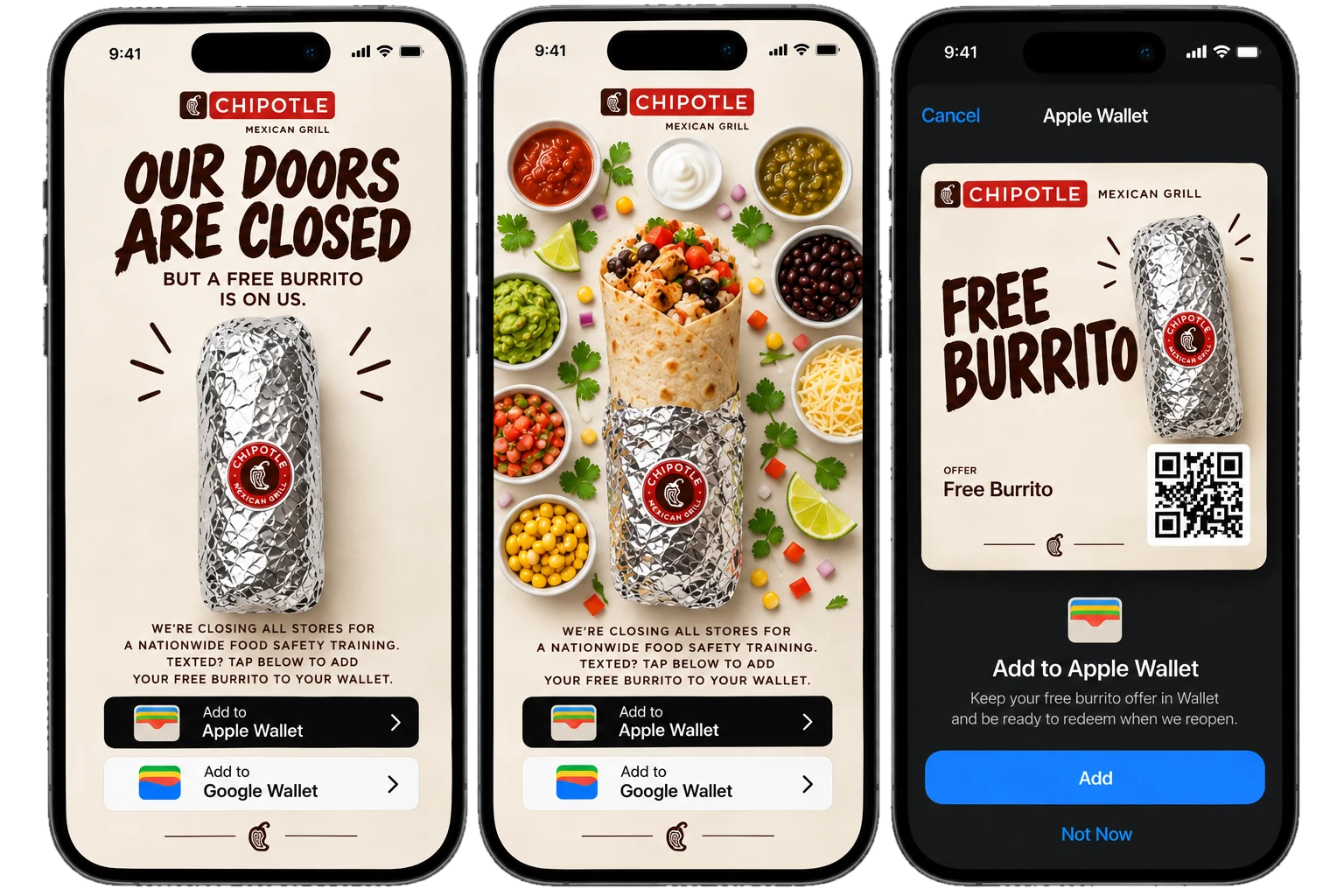
One keyword. Every door in the country.
Chipotle closed its U.S. restaurants until 3 p.m. for a company-wide food safety meeting. Signs on every door invited customers to text RAINCHECK to 888222 for a free burrito, with a texting window that closed at 6 p.m. Eastern the same day.
Vibes ran the messaging behind that sign. The brand was under intense public attention, so the experience had to be warm, fast and flawless for millions of people arriving at once.
That set three priorities for my part of it, the page people landed on after the text.
No app to download. Just a text and the wallet already on the phone.
Five steps, each as short as we could make it. The landing page was the one moment Chipotle had a customer’s full attention, so that’s where the brand showed up.
A burrito that unwraps itself.
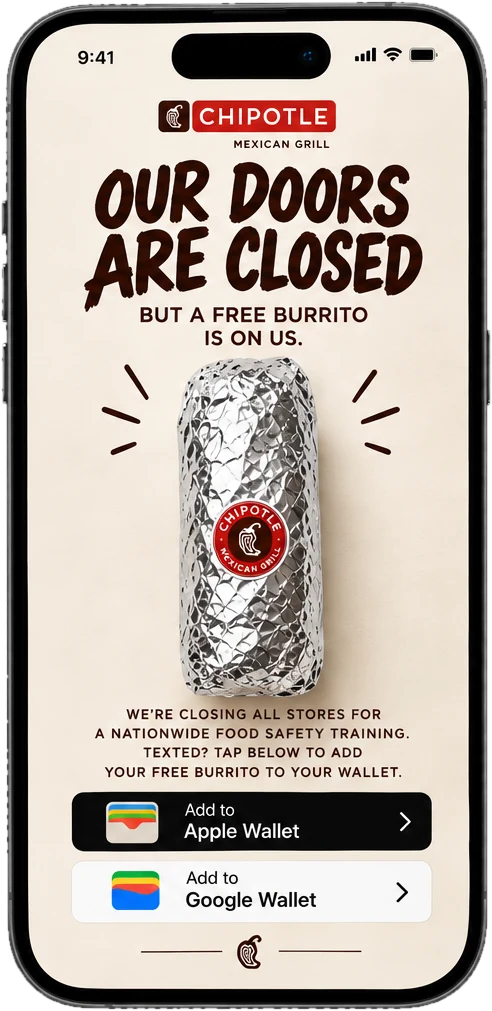
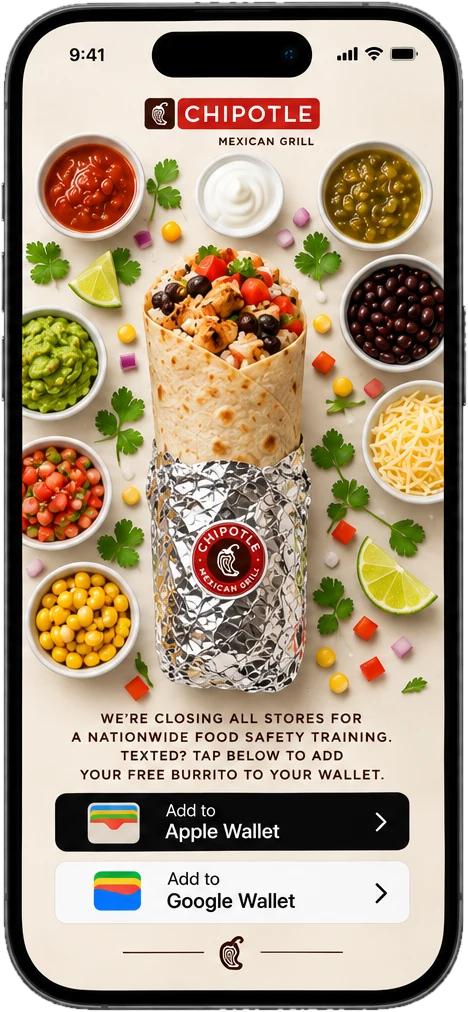
I led the brainstorm for the landing page. Working from Chipotle’s brand guidelines, we landed on a foil-wrapped burrito in a handmade, stop-motion style. It jiggles, unwraps, and little bowls of ingredients move out and dance around it. Then the offer and the Add to Wallet button take over.
Stop motion, without a video.
The burrito was never a video. Video would have been heavy and slow to start at the exact moment millions of people tapped the link. Instead it was lightweight images, sequenced in the browser with GSAP. Small files, any browser, any phone.
NOTE — The clip shown here is a recording made for this case study. In 2016 the animation ran live in the browser.
A coupon that can’t get lost.
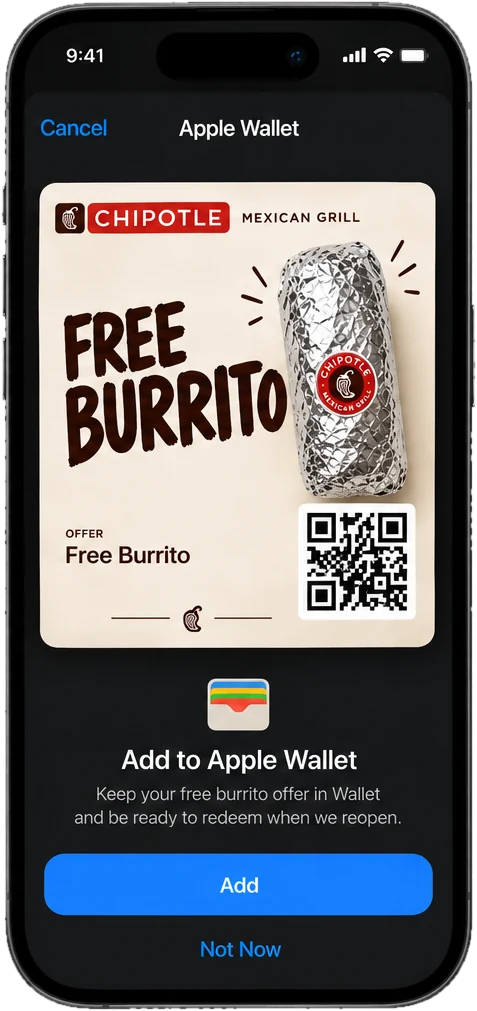
The offer lived in Apple Wallet as a pass built with PassKit, Apple’s framework for Wallet cards. No app, no account, no printout. At the register, the customer opened Wallet and the code was scanned.
A pass gives you a logo, a strip image, a few fields and a barcode. Getting a brand moment out of that meant designing every asset with care.
More than twice the response Chipotle planned for.
Chipotle expected about 2.5 million requests. It got 5.3 million in roughly five hours, and most people who asked for a burrito came back to claim it.
From one-off campaign to self-serve feature.
RAINCHECK proved the text-to-Wallet flow at national scale, but it was still custom work. Brands paid for a seat on the Vibes SMS platform and again for every experience our team built. Verizon, Home Depot, Lane Bryant and Ralph Lauren all asked the same question: when can we do this ourselves?
I helped bring it into the platform, carrying over what the pilots taught us: the compliance copy legal required, how brand assets display on a pass, and the steps a marketer needs to launch alone. Much of the job was translating between design, product and engineering.
NOTE — The five steps reflect a reconstructed wireframe of the campaign builder, not the shipped product UI.
Delight is only worth it if it never gets in the way.
On a day when Chipotle needed goodwill, a dancing burrito did more than a plain coupon page could. But the animation only earned its place because it was light enough that nobody waited for it.
The campaign also showed what pilots are for. One brand’s custom build answered questions the platform needed answered, and enough brands asked for it that it became a product.